

Capacitors: Storing Charge, Shaping Circuits
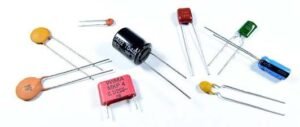
If resistors are the traffic police of electronics, capacitors are the storage tanks. They hold electrical energy temporarily and release it when needed, and this simple ability makes them one of the most versatile components in any circuit. Let’s take a closer look.
What Is a Capacitor?
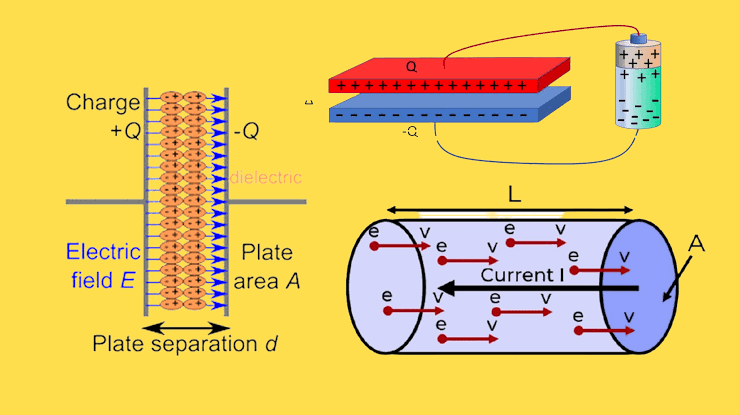
A capacitor is a passive component that stores energy in an electric field. At its simplest, it consists of two conductive plates separated by an insulating material called a dielectric. When a voltage is applied across the plates, positive charge accumulates on one plate and negative charge on the other, creating an electric field in the dielectric.
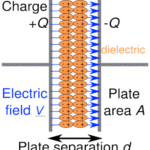
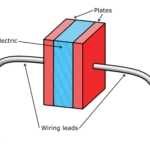
The ability to store charge is called capacitance, measured in farads (F). One farad is a very large value, so most practical capacitors are rated in microfarads (µF), nanofarads (nF), or picofarads (pF).
The capacitance depends on three things:
- Plate area – larger plates store more charge.
- Distance between plates – closer plates increase capacitance.
- Dielectric material – materials with higher permittivity (like ceramics or electrolytic compounds) increase capacitance.
Types of Capacitor
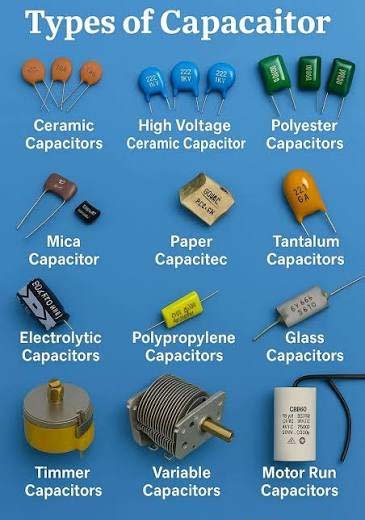
Capacitors come in many forms, each suited to different jobs:
- Ceramic capacitors – small, cheap, and stable. Common in high-frequency and filtering applications.
- Electrolytic capacitors – high capacitance in a compact size, but polarized (they must be connected with correct polarity). Used in power supplies.
- Tantalum capacitors – stable and compact, also polarized. Found in compact electronics.
- Film capacitors – very stable and reliable, used in precision and AC applications.
- Supercapacitors – extremely high capacitance, used for energy storage and backup power.
- Variable capacitors – adjustable capacitance, often used in tuning circuits (like old radios).
Capacitors in DC and AC Circuits
The behavior of a capacitor depends heavily on the type of current:
In DC circuits:
Once a capacitor charges to the applied voltage, it blocks further direct current. This makes it useful for:
- Coupling – passing a signal while blocking DC offset.
- Decoupling/bypassing – shunting noise to ground to keep power rails clean.
- Energy storage – holding charge for flash units, backup systems, etc.

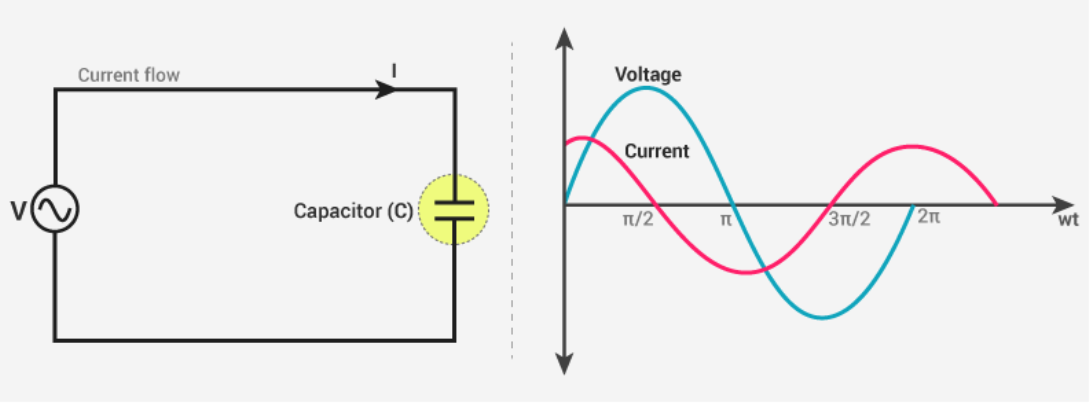
In AC circuits:
A capacitor continuously charges and discharges as the voltage alternates, so it appears to pass AC current. Its opposition to current flow is called capacitive reactance (Xc), which decreases as frequency increases:
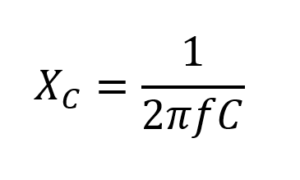
This frequency-dependent behavior makes capacitors essential in:
- Filters – blocking low frequencies while passing high frequencies (or vice versa).
- Tuning circuits – selecting radio frequencies.
- Phase shifting – in motor starting circuits.
Series and Parallel Connections
Capacitors combine in the opposite way to resistors:
In parallel:

Capacitances add up, because the total plate area effectively increases.
In series:
The total capacitance is less than the smallest individual capacitor, and voltage is divided among them.

This mirror-image behavior compared to resistors is a common point of confusion, so it’s worth memorizing.
Charging and Discharging
When a capacitor is connected to a voltage source through a resistor, it doesn’t charge instantly. The RC time constant (τ = R × C) determines how fast it charges or discharges:
After 1τ, the capacitor reaches about 63% of the supply voltage.
After 5τ, it’s considered fully charged (over 99%).
The charging and discharging follow exponential curves:
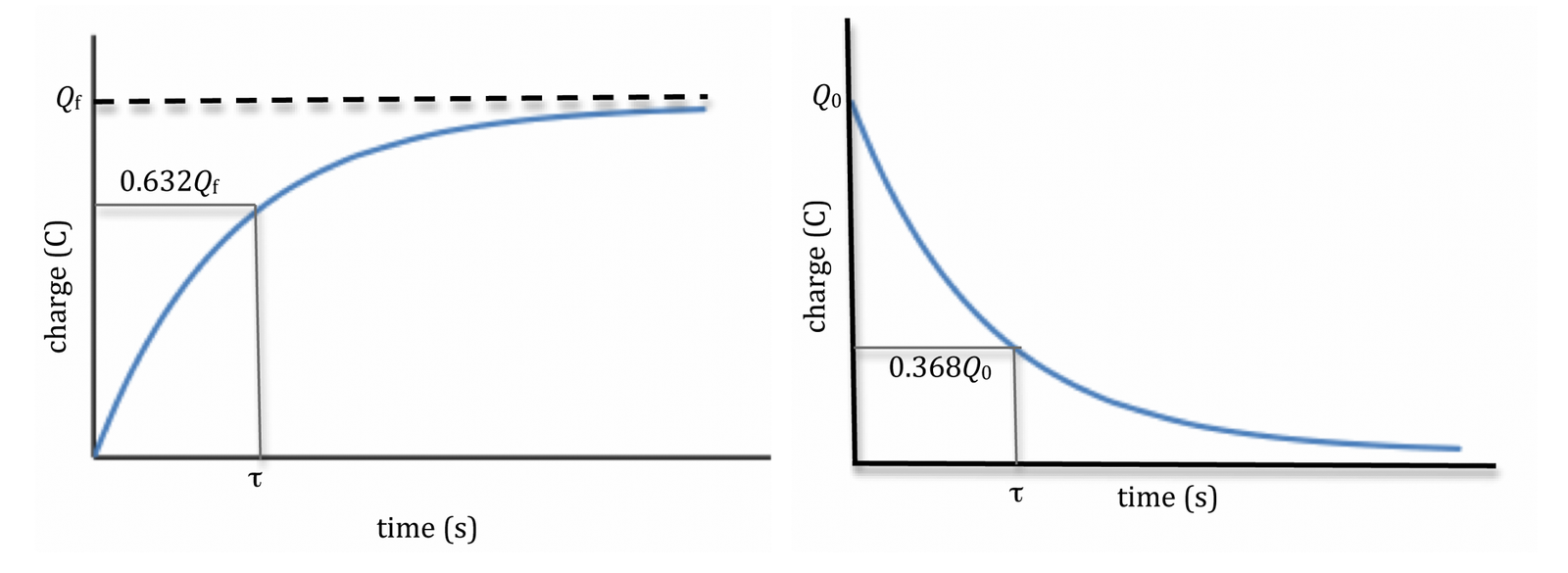

This predictable timing is why capacitors are used in timers, oscillators, and delay circuits.
Capacitors vs. Batteries: A Key Clarification
People often confuse capacitors with batteries because both store electrical energy, but they work very differently:
Feature | Capacitor | Battery |
Storage method | Electric field | Chemical reaction |
Charge/discharge speed | Very fast | Slow |
Energy density | Low | High |
Power density | High | Lower |
Lifespan | Long (millions of cycles) | Limited cycles |
Voltage behavior | Drops steadily as it discharges | Relatively stable until depleted |
In short: a capacitor is like a spring that releases energy almost instantly, while a battery is like a fuel tank that releases energy slowly and steadily. Capacitors are used for bursts of power and fast timing; batteries are used for sustained energy over time.
Final Thoughts
Capacitors are deceptively simple but enormously powerful in what they enable: clean power, filtered signals, timed pulses, and stored energy on demand. Understanding their behavior in DC and AC, how they combine, and how they charge and discharge gives you the foundation to design and troubleshoot a huge range of circuits.

Leave a Reply