


Description
Purpose & Audience:
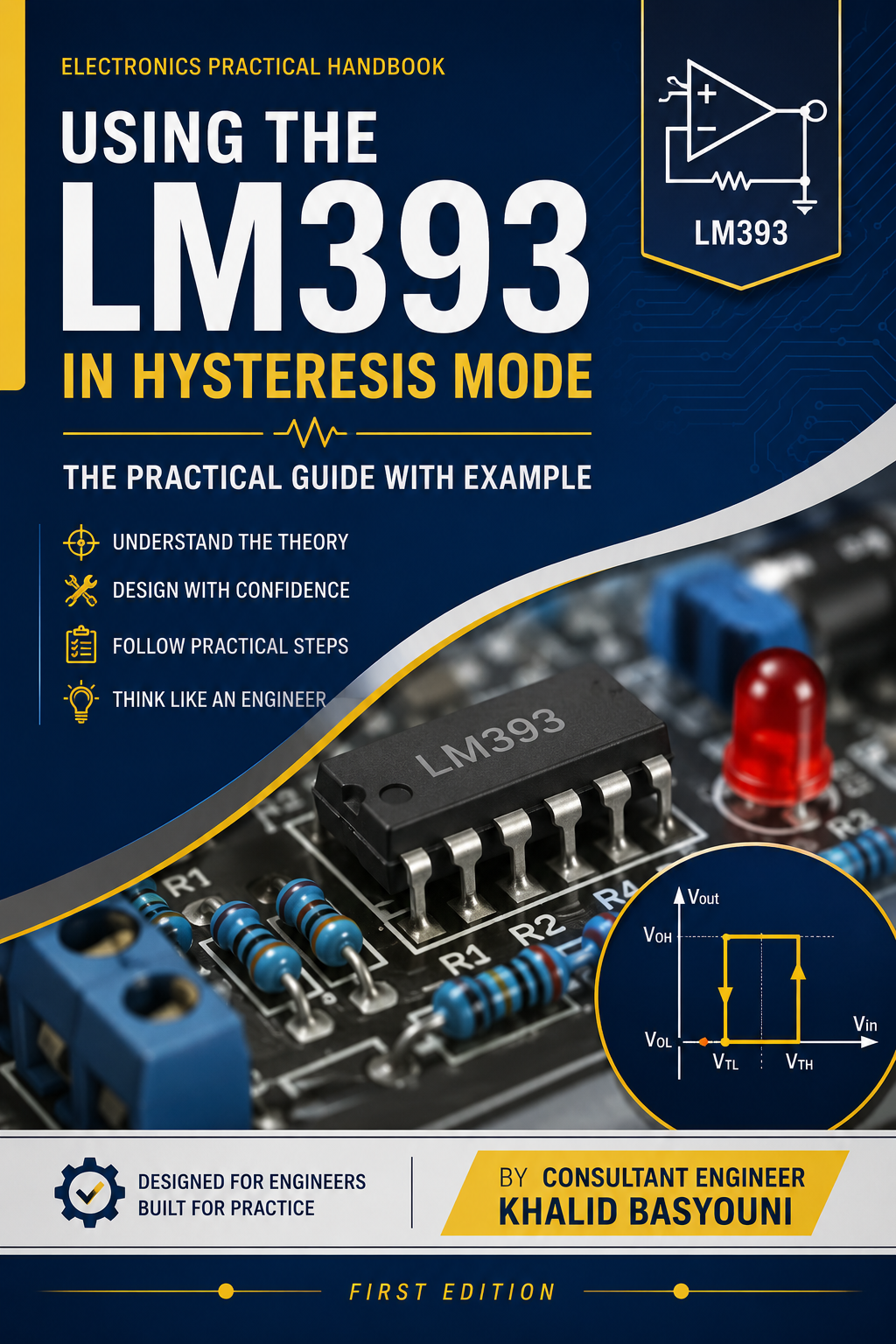
This handbook by Engineer Khalid Basyouni is a concise, practical guide for engineers, students, technicians, and hobbyists seeking to understand and design comparator circuits with hysteresis. It bridges the gap between theory and real-world application, emphasizing
logical engineering thinking over rote memorization of formulas.
Key Concepts:
- Comparator Basics: Comparators are widely used ICs. They determine if an input voltage is above or below a reference, but in noisy environments, this can cause unstable outputs (chatter).
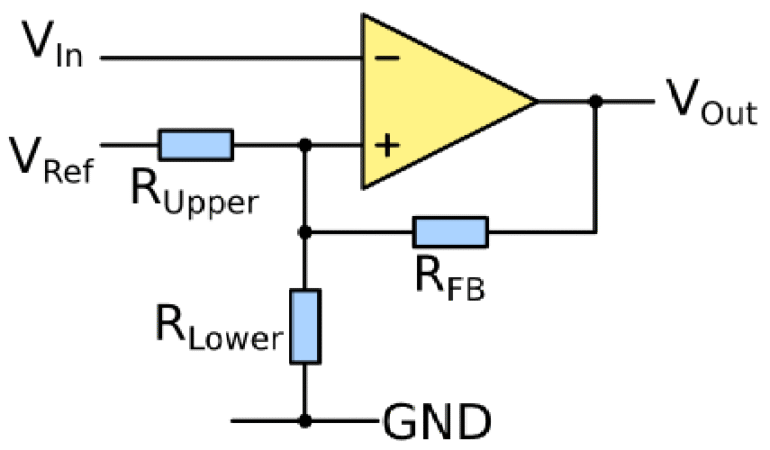
- Hysteresis Principle: Adding positive feedback creates two switching thresholds (upper and lower), giving the circuit memory and greatly improving noise immunity and stability. This is essential for reliable analog-to-digital interfacing.
Design Approach:
- The book introduces both non-inverting and inverting comparator configurations with hysteresis, explaining their operation, mathematical analysis, and practical design steps.
- Design Workflow:
- Define application requirements and switching thresholds.
- Calculate hysteresis width and select reference voltage.
- Use provided equations to determine resistor values.
- Choose standard resistor values, verify calculations, and test the circuit.
- Worked Example: A step-by-step design is provided, showing how to select resistor values for specified thresholds using standard components, and how to verify the design experimentally.
Practical Guidance:
- Emphasizes the importance of stable reference voltages, careful resistor selection, clean power supplies, and good PCB layout.
- Includes troubleshooting tips for common issues (e.g., output oscillation, incorrect thresholds, missing pull-up resistor).
- Offers a quick reference checklist and troubleshooting table for rapid design and debugging.
Engineering Philosophy:
- Start with clear requirements, use mathematics as a tool, and always verify designs experimentally.
- Learn from mistakes and focus on understanding circuit behavior, not just calculations.
Conclusion: The handbook is both a technical reference and a guide to disciplined engineering thinking. It encourages readers to experiment, verify, and continuously improve their designs, applying these principles beyond the LM393 to broader engineering challenges.
Electron –
This is a good book